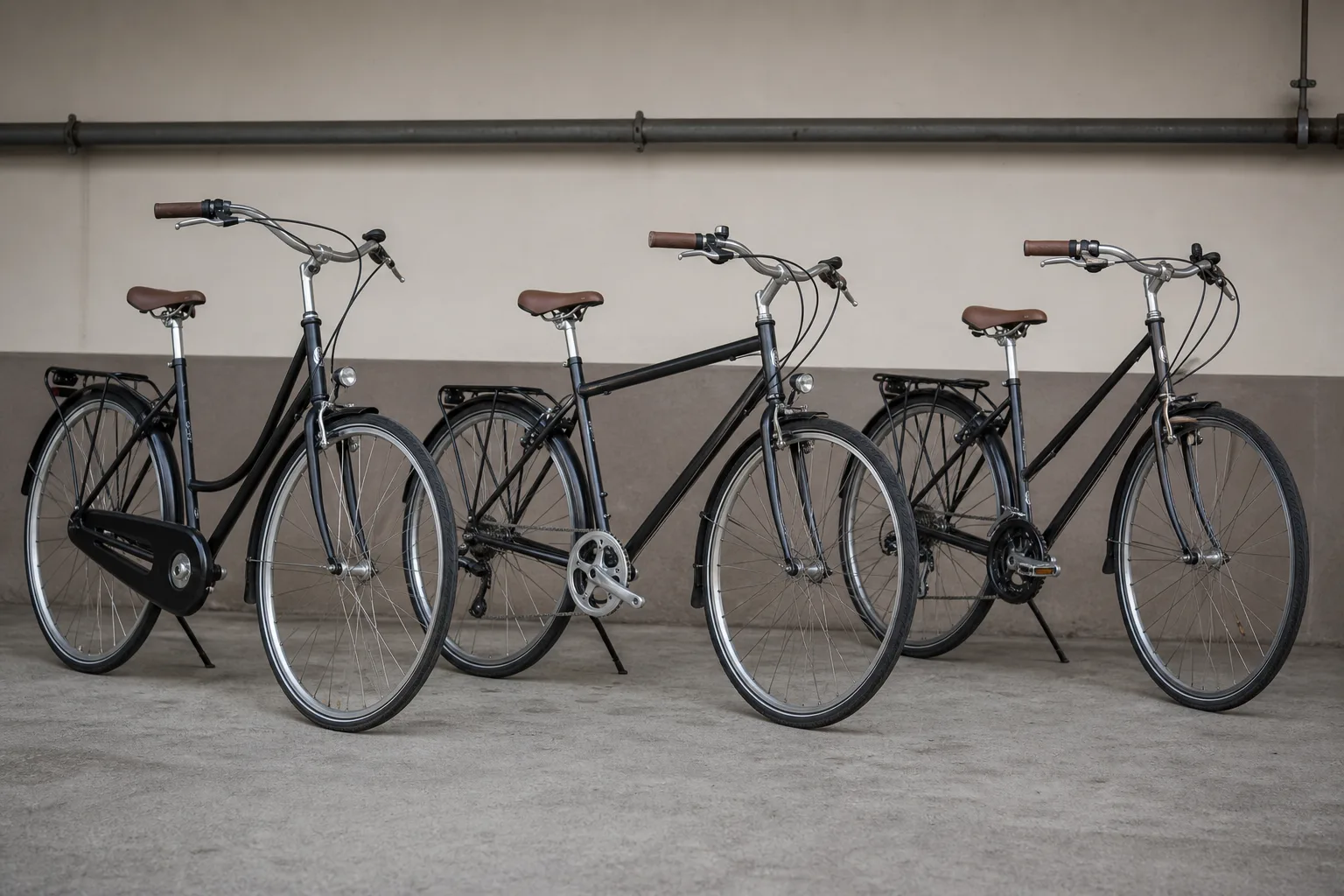
The decision most people actually face on a comfort bike is narrower than the catalog suggests: one gear, an internally geared three, or an external seven, and whichever brake the manufacturer bolted on to match. On genuinely flat ground, over a mile or two, all three drivetrains will get you there. The differences show up at the margins, which is to say at the bridge approach, into a stiff onshore wind, and with fifteen pounds of groceries hanging off the rear rack. Those margins are where a careful buyer spends their attention.
What each drivetrain does once the bike is loaded
A single speed is a bet that your route never asks for more than one ratio, and on a flat boardwalk that bet is usually sound until the wind turns. Loaded, a single speed makes you stand up and grind, which is fine occasionally and tiring daily. A three-speed internal hub gives you a low gear for starting from a stop with cargo, a middle for cruising, and a high for a tailwind, and it shifts while you are stopped, which matters at every light. A seven-speed derailleur gives finer steps and a wider spread, at the cost of an exposed chain, a hanging derailleur and a cable that drifts out of adjustment. Ask yourself how often you will actually use gears four, five and six.
Weight tells the same story from another direction. Internal hubs are heavy, and on a bike that already weighs what a cruiser weighs, another pound or two changes little except how it feels to lift onto a porch. Derailleur systems are lighter and cheaper to buy, and they are the only option with a genuinely wide range if your flat town has one unavoidable rise. The check worth making in the shop is simple: load the rear rack with something heavy, ride a slow circle, and shift under mild pressure. A hub takes it. A derailleur complains, sometimes politely, sometimes not.
Brakes, and what rain actually does to each
Rim brakes squeeze the wheel rim itself, so in the first second of wet braking they are wiping water off before they can bite, and that first second gets longer as the pads wear and the rim glazes. They are still perfectly workable on a light bike at boardwalk speeds, and they are trivially easy to inspect, since you can see the pad, the rim and the gap between them without tools. Coaster brakes, the ones you engage by pedaling backward, are sealed inside the hub and therefore indifferent to rain, which is their real advantage, though they give you no front braking at all and no way to hold the bike still on a slope while you dismount. Drum brakes are also sealed, also indifferent to weather, and heavier still. Disc brakes are the strongest of the group and shed water fastest, and on a loaded bike carrying cargo they are the most predictable choice in a downpour.
The Consumer Product Safety Commission is the federal body responsible for bicycle requirements sold in the United States, including how braking systems on new bikes are specified. That covers the floor, not the ceiling, and the ceiling is where the interesting decisions live. A careful reader checks two things beyond the spec sheet: whether the bike has any front braking at all, and whether the levers reach comfortably from an upright hand position, because a strong brake you cannot squeeze from where you sit is not a strong brake.
What each combination costs to keep running
Service cost is mostly a question of who can do the work. Rim brake pads and a derailleur cable are the cheapest maintenance items on any bicycle, sold everywhere, replaceable at a kitchen table with two hex keys, and a shop will charge you a small labor minimum to do it while you wait. Chains and cassettes on a seven-speed wear as a set and want replacing on a schedule rather than after failure, which is a recurring but modest expense. Internal hubs need almost nothing for years, then need an oil change or a shop service that costs meaningfully more per visit, and fewer mechanics are eager to open one. Coaster and drum brakes hide their wear entirely, so plan on a wheel coming out of the frame to inspect them.
Disc brakes sit in the middle: pads are cheap and quick, rotors last a long time, and hydraulic systems want a bleed occasionally. Before you buy, call the shop nearest you and ask what they service in-house. A drivetrain that has to be shipped somewhere is a different ownership experience than one your local shop fixes on a Tuesday.
The check that settles most of it
Ride the candidate bike on your actual worst day, not your average one. Loaded, into the wind, on wet pavement, from a dead stop at a light. Most people find they want more starting gear and more wet stopping power than a bare specification implied, and that a three-speed hub with a front brake covers the territory with the least fuss. The pleasure of the right combination is that you stop thinking about it, which is the whole point of a bike you ride to the store.